

Introduction
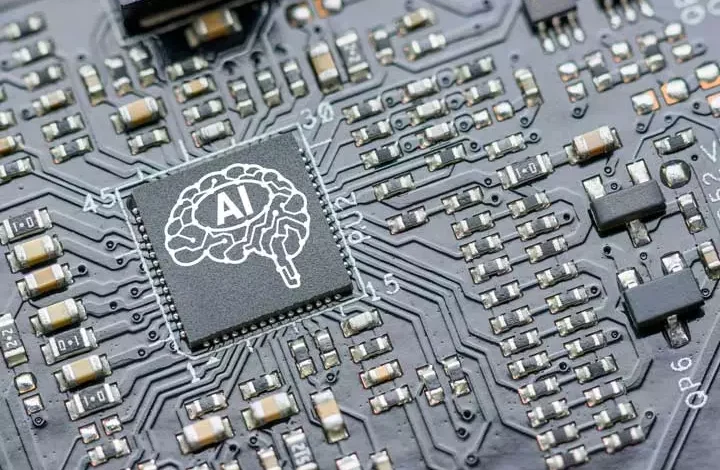
Edge AI chips represent a major shift in how artificial intelligence workloads are executed. Instead of sending data to distant cloud servers, these specialized processors enable devices to run AI models locally. This approach significantly improves speed, privacy, and reliability—making it essential for next-generation IoT systems, autonomous machines, healthcare wearables, and smart consumer electronics.
What Are Edge AI Chips?
Edge AI chips are purpose-built processors designed to accelerate machine learning tasks directly on devices such as sensors, cameras, smartphones, and autonomous robots. Unlike traditional CPUs or GPUs, they are optimized for:
-
Low power consumption
-
High-performance inferencing
-
Real-time processing
-
Secure, local data handling
These chips often integrate neural processing units (NPUs), digital signal processors (DSPs), and optimized memory architectures to execute AI workloads efficiently.
Why Edge AI Matters
Real-Time Decision Making
On-device processing removes cloud latency. For applications like autonomous driving, industrial automation, or medical monitoring, even milliseconds matter.
Strong Privacy & Security
Sensitive data—such as video streams, health metrics, or voice recordings—doesn’t need to leave the device. This reduces exposure to cyber risks and helps meet strict data regulations.
Reduced Cloud Costs
Local inference minimizes the need for constant cloud communication, lowering bandwidth usage and long-term operational costs.
Improved Reliability
Edge devices continue functioning even with poor or no internet connectivity. This is critical for remote sites, field equipment, or mission-critical systems.
How Edge AI Chips Work
Edge AI chips process AI models through specialized hardware units:
Neural Processing Units (NPUs)
Designed to accelerate matrix calculations required for deep learning inference.
Digital Signal Processors (DSPs)
Handle audio, image, and sensor data preprocessing tasks efficiently.
Integrated Memory Hierarchies
Reduce the need to fetch data from external memory, improving both speed and power efficiency.
Hardware Acceleration for ML Frameworks
Most edge AI chips support TensorFlow Lite, ONNX Runtime, and PyTorch Mobile for optimized deployment.
Key Applications of Edge AI Chips
Smart Cameras & Surveillance
Edge chips enable object detection, facial recognition, and anomaly identification directly within the camera device, reducing cloud dependence.
Healthcare Wearables
Real-time ECG analysis, fall detection, and biometric monitoring run locally, ensuring accuracy and patient privacy.
Industrial Automation
Robots and machinery equipped with edge processors can instantly react to sensor inputs, maintaining precision and safety in operations.
Autonomous Vehicles & Drones
Local inference supports navigation, obstacle avoidance, and environment mapping without requiring external servers.
Consumer Electronics
Voice assistants, smart appliances, and AR/VR devices increasingly rely on efficient edge computation for seamless experiences.
Benefits of Edge AI Chips
-
Ultra-low latency performance
-
Enhanced data protection
-
Efficient power utilization
-
Lower dependency on external networks
-
Scalable deployment across distributed systems
Challenges in Edge AI Chip Development
Model Optimization
AI models must be compressed—often through quantization or pruning—to run efficiently on limited hardware.
Hardware Constraints
Balancing power, heat, and performance within compact devices requires sophisticated engineering.
Interoperability
Different chip vendors use different toolchains, which can complicate AI deployment across platforms.
Cost of Integration
Embedding advanced chips in consumer hardware raises production costs, which companies must carefully manage.
Future Trends of Edge AI Chips
Heterogeneous Computing
Future chips will blend NPUs, GPUs, CPUs, and dedicated accelerators into unified architectures.
More On-Device Training
Today, edge devices mainly run inference. Soon, lightweight on-device training will enable continuous personalization.
Advanced AI Model Compression
New techniques will help large models run efficiently even on ultra-small devices.
Integration with 6G and IoT
High-speed connectivity combined with local AI processing will unlock smarter, more autonomous ecosystems.
Frequently Asked Questions (FAQ)
1. How do edge AI chips differ from standard AI accelerators?
Edge AI chips are optimized for low-power, real-time inference directly on devices, whereas standard accelerators typically rely on cloud infrastructure.
2. Do edge AI chips support large AI models?
They support optimized or compressed models. Full-scale training or huge transformer models usually remain cloud-based.
3. Are edge AI chips secure?
Yes. Many incorporate secure enclaves, hardware-level encryption, and protected execution zones to safeguard data.
4. Can edge AI work without internet connectivity?
Absolutely. Local inference enables uninterrupted operation even in offline environments.
5. Which devices typically use edge AI chips?
Smartphones, drones, surveillance cameras, wearables, robotics systems, and smart home appliances.
6. Are edge AI chips energy efficient?
They are engineered for low power consumption, making them suitable for battery-operated devices.
7. How do developers deploy models onto edge chips?
Using frameworks like TensorFlow Lite, ONNX Runtime, or vendor-specific SDKs that optimize models for the target hardware.